
The Demineralization Myth: Why Your Water Purifier Should Only Do One Thing.
Introduction
There is a common misconception floating around the wellness industry: that Reverse Osmosis (RO) water is "dead" water. Critics argue that because RO membranes are so effective, they strip water of essential minerals, potentially causing health issues.
This fear has birthed a massive industry of "re-mineralization" cartridges and alkaline add-ons. But before you spend extra money trying to put things back into your water, you need to ask yourself a more important question: What are you trying to take out?
Is it safe to drink demineralized RO water?
Yes, it is safe. While Reverse Osmosis (RO) removes minerals like calcium and magnesium, the amounts found in tap water are negligible compared to food sources. The primary function of an RO system is to remove harmful contaminants like lead, arsenic, and PFAS. Health experts agree that a balanced diet, not water, is the most effective way to obtain necessary daily minerals.

According to a report by the World Health Organization (WHO), the majority of essential nutrients are derived from food, not fluids.
The "Demineralization" Scare: A Mathematical Reality Check
It is true that RO systems remove 90-99% of dissolved solids, including good minerals like calcium and magnesium. However, water is a terribly inefficient delivery system for these nutrients.
To put it in perspective:
You would need to drink hundreds of glasses of tap water to get the calcium found in a single cup of yogurt or a serving of spinach.
The minerals in water are inorganic, which some studies suggest are harder for the body to absorb compared to the organic minerals found in food.
Relying on tap water for your mineral intake is like trying to fuel a car with the fumes at a gas station. It’s simply not enough.
| Nutrient | Amount in 1 Liter of Avg. Tap Water | Amount in Common Food Source | The "Water Equivalent" |
| Calcium | ~30 mg | 1 Cup Milk: 300 mg | You need to drink 10 Liters of water to equal 1 cup of milk. |
| Magnesium | ~10 mg | 1 Cup Spinach: 157 mg | You need to drink 15 Liters of water to equal 1 cup of spinach. |
| Potassium | ~2 mg | 1 Banana: 422 mg | You need to drink 211 Liters of water to equal 1 banana. |
| Iron | <0.1 mg | 1 Cup Lentils: 6.6 mg | You need to drink 60+ Liters of water to equal 1 cup of lentils. |
The Real Danger: What Lurks in "Mineral-Rich" Tap Water?
While we worry about losing a tiny fraction of our daily calcium intake, we ignore the elephant in the room. The same water containing those trace minerals often carries a cocktail of modern contaminants that your body cannot filter out on its own.
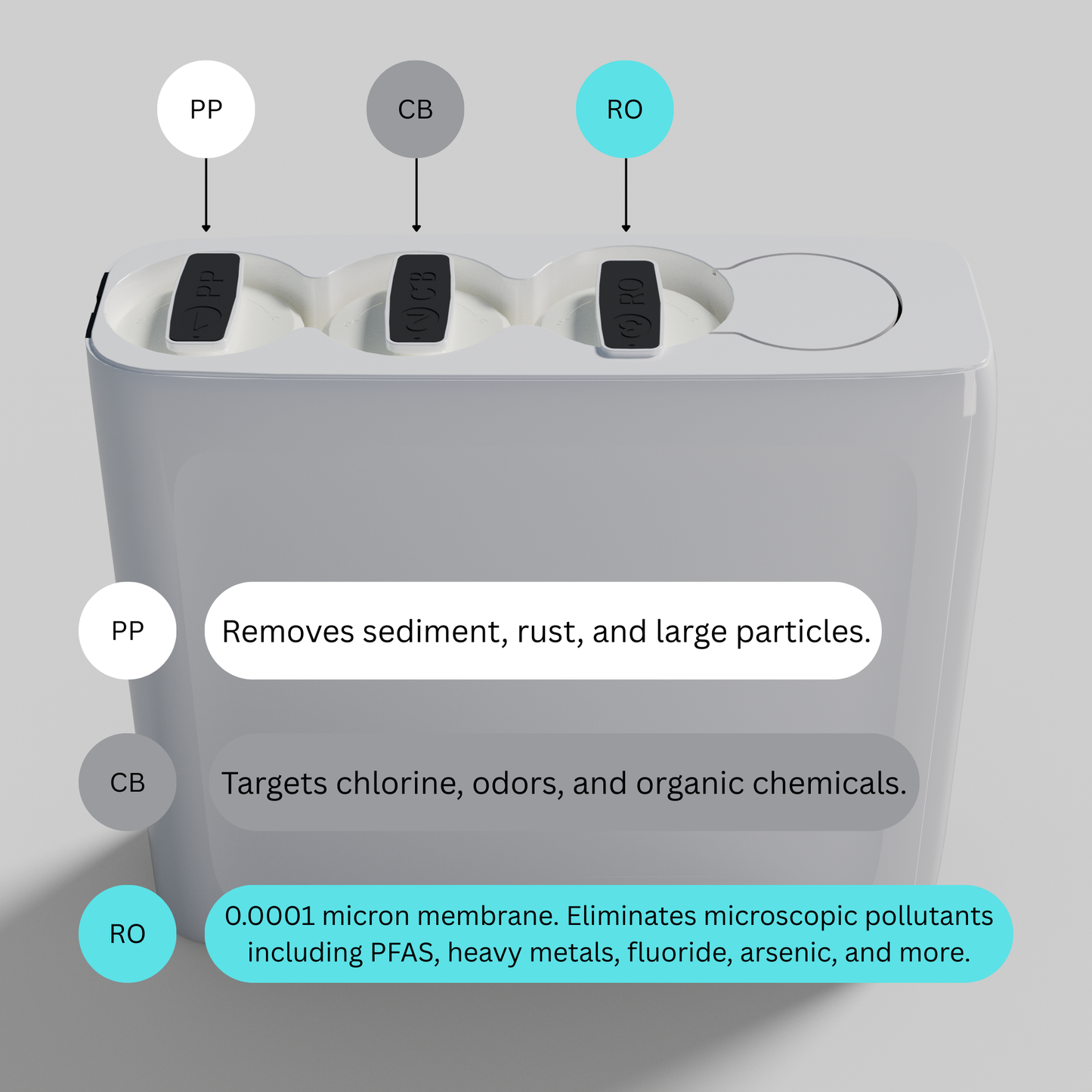
An effective RO purifier is designed to remove:
Heavy Metals: Lead, Arsenic, and Mercury.
Chemical Runoff: Pesticides, nitrates, and fertilizers.
"Forever Chemicals": PFAS and microplastics.
Biological threats: Cysts, bacteria, and viruses.
If you choose a less effective filter (or add a re-mineralization stage that bypasses the membrane) to "save the minerals," you are often leaving the door open for these toxins. The trade-off isn't worth it.
The Contaminant Trade-off: The U.S. Environmental Protection Agency (EPA) actively regulates over 90 contaminants in drinking water, including arsenic, lead, and mercury. The risk of consuming these regulated toxins far outweighs the benefit of the trace minerals found in the same water.
Verify the list here: EPA National Primary Drinking Water Regulations
The Philosophy of Maximum Purity
A water purifier has one job: Purify.
The goal of drinking water is hydration and solvent action—it helps transport nutrients from your food to your cells and flushes waste out. The cleaner the water, the better it performs this job.
Adding a "re-mineralizer" stage often introduces a point of failure. These cartridges can sometimes harbor bacteria if not changed frequently, or they may add uncontrolled amounts of solids back into the water you just spent energy cleaning.
The Solution is on Your Plate, Not in Your Cup
If you are concerned about mineral deficiency, the solution isn't to drink dirty water; the solution is to fix your diet.
Need Calcium? Eat leafy greens, dairy, or fortified alternatives.
Need Magnesium? Eat nuts, seeds, and whole grains.
Conclusion
Don't let the fear of demineralization stop you from protecting your family from genuine waterborne threats. The safest water is the purest water. Let your RO system do its job—removing the bad stuff—and let your diet handle the rest.
Bioavailability Reality: A study highlighted by the National Institutes of Health (PubMed) notes that while water can contribute to mineral intake, for most populations, it provides a small fraction (often <10%) of the Recommended Daily Allowance (RDA) compared to dietary sources.
Read the research: Contribution of Drinking Water to Mineral Nutrition (NCBI/PubMed) (Note: This link directs to a relevant review on mineral intake efficiency).
About the Author: AquaByte
AquaByte is a leader in advanced water purification technology, specializing in high-efficiency Reverse Osmosis (RO) systems designed for modern homes. Unlike general appliance retailers, we focus exclusively on water quality engineering. Our mission is to cut through the wellness noise and provide families with the purest baseline of water possible—free from heavy metals, microplastics, and industrial runoff—so you can build health on a clean foundation.